Organized workplace case timeline notes and evidence checklist on a desk
YOUR JUSTICE COMPASS

Workplace discrimination clarity

Learn the law. Organize your facts. Prepare your next step.

Your Justice Compass helps workers understand workplace discrimination basics, federal civil procedure for people representing themselves, evidence, timelines, and the strengths and weaknesses of a situation before deciding what to do next.

Free legal education after registration

Workplace discrimination + retaliation focus

Organize facts and understand case strengths

Educational tools only. Not a law firm, not legal advice, and no attorney-client relationship.

Free after registration

Knowledge library preview

Workplace discrimination law basics

Protected classes, retaliation, accommodations, evidence, comparator facts, deadlines, and damages.

Litigation process for people representing themselves

Complaint basics, service, motions, scheduling orders, discovery, and summary judgment orientation.

Arbitration basics

Arbitration agreements, private forum rules, discovery limits, hearing process, costs, deadlines, and awards.

Deeper case understanding after login

Guided workflows help organize facts, examine strengths and weaknesses, and learn the rules and procedure of civil cases.

Free registration

Three education pillars before deeper case guidance.

Free registered users can learn the legal landscape and the civil procedure process for people representing themselves, with tutorials built into each topic before guided workflows for deeper case organization.

Workplace discrimination law basics

Plain-language lessons on protected classes, adverse actions, retaliation, accommodations, comparator evidence, deadlines, damages, and common proof issues.

  • Discrimination vs. unfair treatment
  • Protected activity and retaliation
  • Reasonable accommodation basics
  • Evidence, comparators, and timelines

Arbitration basics

A plain-language guide to workplace arbitration agreements, private arbitration process, deadlines, costs, discovery limits, and award review.

  • Arbitration agreement basics
  • Court case vs. private arbitration
  • Discovery and hearing process
  • Arbitration costs, deadlines, and awards

Litigation process for people representing themselves

A practical orientation to federal civil litigation steps for people representing themselves, from complaint structure through discovery and motions.

  • Complaint, summons, and service
  • Answer, motions, and scheduling orders
  • Discovery requests and responses
  • Motion to dismiss and summary judgment basics

Guided workflow

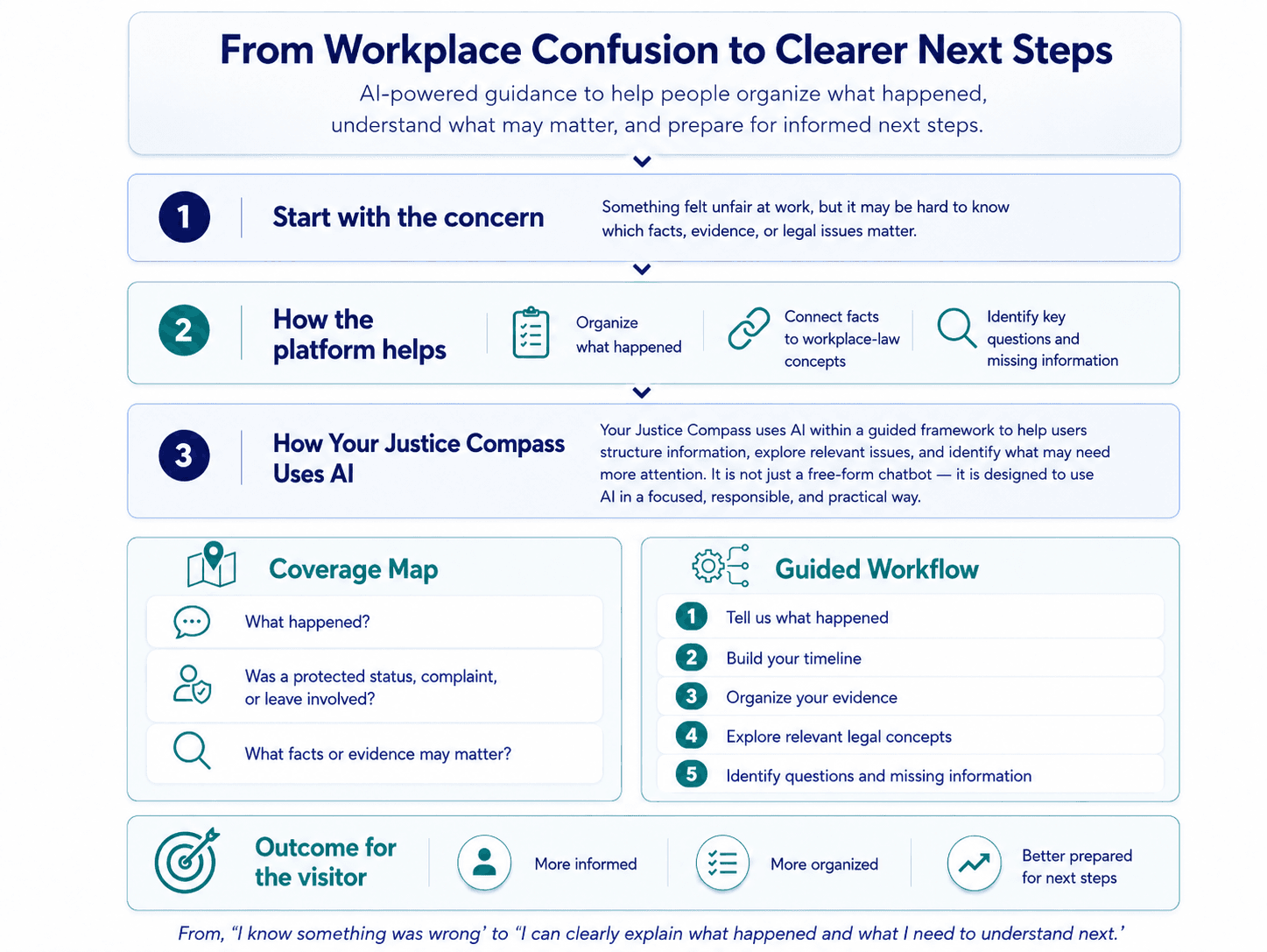
From workplace problem to organized case picture.

Instead of asking users to pick a legal theory first, the platform helps them move from facts to evidence to procedure in a clear sequence.

Step 1

Start with what happened

Begin with plain facts: fired, disciplined, denied leave, paid less, passed over, harassed, or forced out.

Step 2

Build one organized timeline

Put events, dates, people, employer explanations, HR complaints, warnings, and deadlines in one chronology.

Step 3

Connect evidence to issues

Map emails, reviews, policies, witness names, comparator facts, leave records, and damages to the issues they support.

Step 4

Understand strengths and gaps

See what appears supported, what facts are missing, and which rules or procedures may matter next.

Coverage map

Organize the case from three angles.

A worker may know the event, the protected issue, or the process problem first. The system should support all three entry points.

What happened

  • Fired, laid off, demoted, disciplined, or forced out
  • Not hired, not promoted, paid less, or given worse assignments
  • Denied leave, accommodation, return-to-work support, or fair scheduling

Why it may matter

  • Race, color, national origin, sex, pregnancy, age, disability, religion, or LGBTQ+ status
  • Harassment, hostile environment, retaliation, whistleblowing, or protected leave
  • Employer changed reasons, treated comparators differently, or ignored complaints

What process applies

  • Workplace discrimination law basics
  • Arbitration agreements and private arbitration steps
  • Civil procedure for people representing themselves, including motions, discovery, and deadlines

Legal safety

Educational information only.

Your Justice Compass is not a law firm and does not provide legal advice, legal representation, claim valuation, or predictions about whether a case will win.

Use the tools to organize facts and learn general concepts. For deadlines, filings, rights, strategy, or advice about a specific situation, consult a licensed attorney or appropriate legal aid organization.